01Case study
Storiad
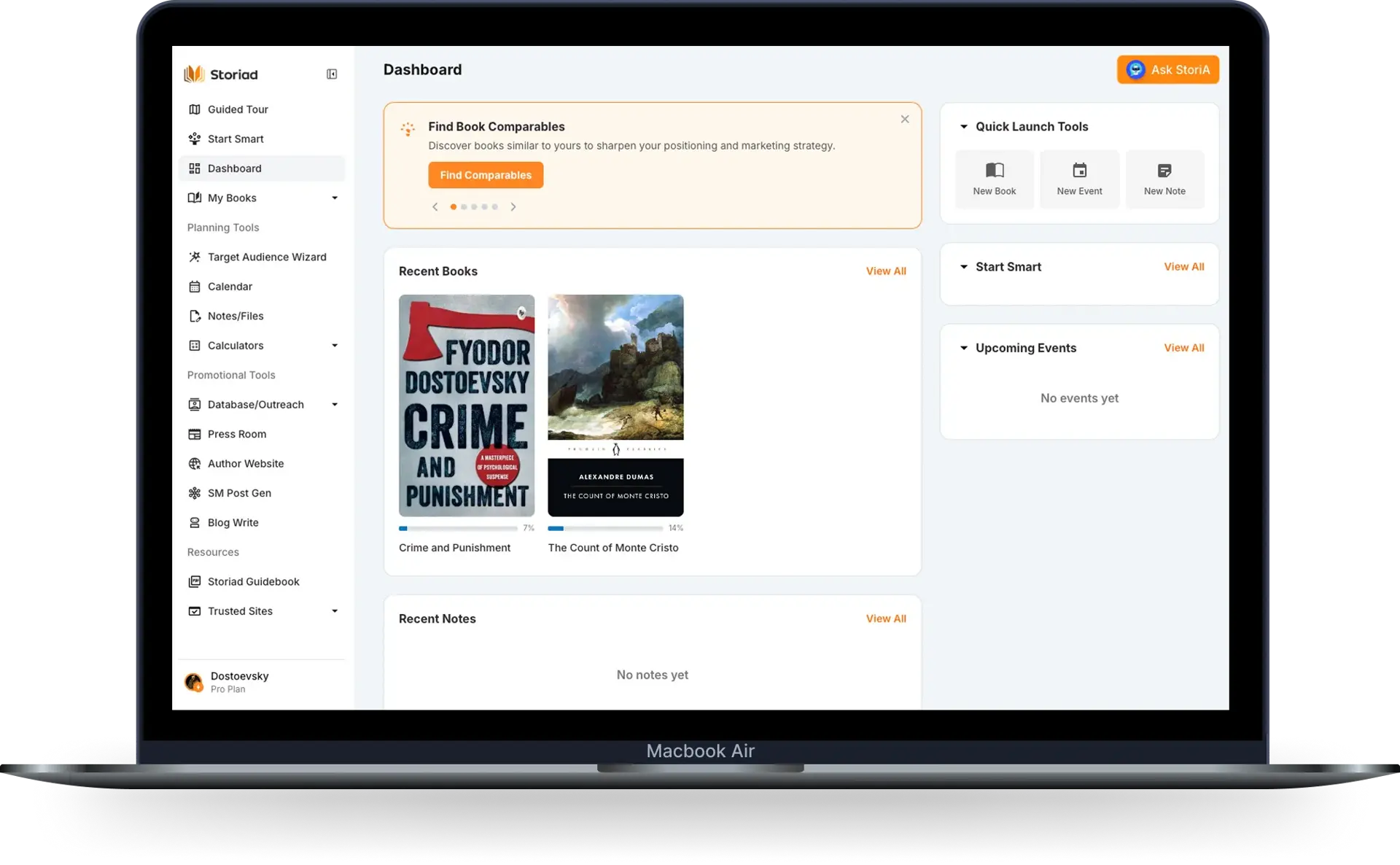
My day job since 2022. Own the Laravel backend of a ~1,000-user publishing platform: led its migration off WordPress, shipped the OpenAI-powered assistant with per-tier usage metering, per-seat Stripe billing, and one-click author-site provisioning.
02Overview
My role
Storiad is where I've worked since April 2022. Self-published authors had no single place to manage their brand, content, and book promotion; the product is one logged-in app that pulls that workflow together.
I own the Laravel backend architecture and data layer — core application logic, data modeling, and queued jobs — and partner with the design team to ship the React interface. Below is what I built along the way.
03What was built
01
Off WordPress
The product had run on WordPress since 2011. I rebuilt it as a Laravel/React app serving nearly 1,000 authors and publishers, and moved the data with a one-time importer: WP exports to CSV, one importer per table, original IDs preserved so every link between records survived. WordPress password hashes came across as-is and are re-hashed to Laravel's format on each user's first successful login, so nobody was forced to reset.
02
StoriA, the in-app assistant
It began as regex matching on the user's message. I replaced that with OpenAI tool calling: nine tools covering navigation, profile, books, contact lists, calendar and workflow state. The tool loop runs in the browser so data tools fire in parallel against the user's own logged-in session, and a sliding-window token manager keeps the system prompt while trimming the oldest turns to a 32k context. Laravel sits behind it as a metering proxy with per-user rate limits and monthly AI quotas per plan tier.
03
Publisher Edition
A B2B tier shipped as one release: a portal for publishers to manage authors, step into an author's account for editorial work, and run analytics, branding and white-label email. Seats bill through Stripe on custom Cashier code: one seat is one invite code, codes are minted only after Checkout succeeds, and revoking or transferring an author re-syncs the subscription quantity. Each publisher gets its own OpenAI project and service account via the Admin API, with per-call cost recorded locally from a price table.
04
Author sites and the public demo
One click from the dashboard provisions an SSL-secured site at handle.storiad.com: Laravel calls a WordPress endpoint I built that drives the Forge API, polls until the site answers, then queues one job per book to push the catalogue across. The public demo runs on its own host: middleware signs every request in as the demo user with nothing in the session, a second layer blocks all writes, and an hourly job deep-copies a live account in one transaction, skipping the run when a row-count fingerprint says nothing changed.
05
Author tooling
A ~67k-row press-contact database with filtered search, bookmarks, dead-link reporting and a link checker, plus spreadsheet import for an author's own lists. Three self-publishing calculators: a sales funnel, book worth with a discounted-cash-flow chart, and P&L by format. The sales calculator is public and embeddable, with framing allowed only on public routes. AI writing on top: blog posts, social post ideas, book descriptions and an audience profile wizard.
04The stack
- laravel
- inertia
- react
- openai
- stripe